Why is Texas oil production falling, and what does produced water have to do with it?
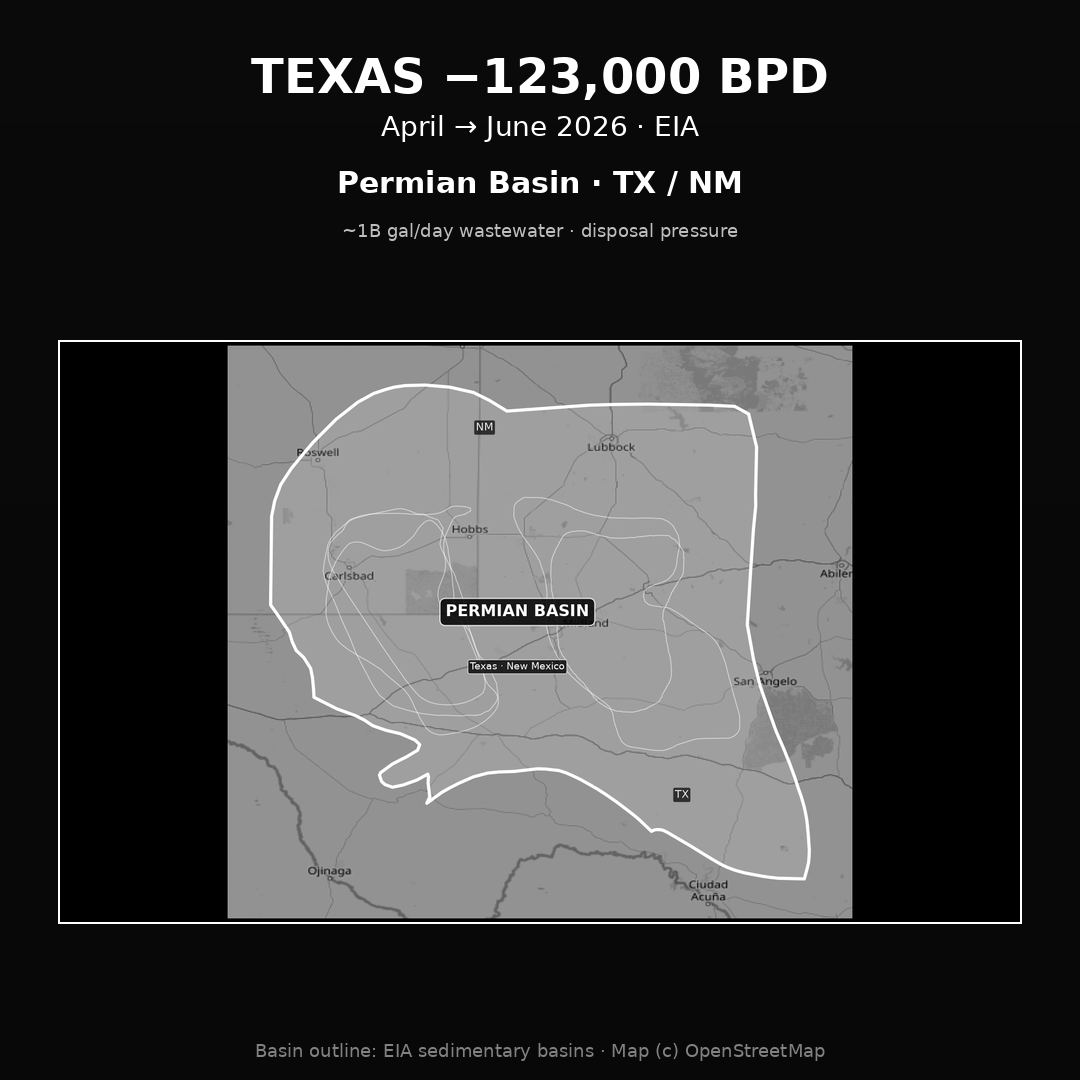
Short answer: Texas crude output dropped about 123,000 barrels a day from April to June 2026, and in the Permian the near term limit is handling and disposing of produced water, not just drilling.
What happened?
According to the U.S. Energy Information Administration (EIA), Texas crude production fell for a second month in a row. It went from 5.851 million barrels a day in April 2026 to 5.728 million barrels a day in June. That is a drop of about 123,000 barrels a day, or 2.1 percent in two months. Texas made up roughly 65 percent of the total U.S. decline over that time.
Is U.S. oil output going down overall?
No. National output is still forecast to climb into 2027. The slowdown shows up first in Texas and the Permian Basin.
Why does water matter so much in the Permian?
The Permian, which spans West Texas and southeast New Mexico, makes about 1 billion gallons of produced wastewater every day. Disposal capacity is under pressure, and the Railroad Commission of Texas is already tighter on how much operators can inject and at what pressure. So the real limit on growth is how fast you can move and dispose of water.
What can you control at the tank?
Oil floating on top of the water in your tanks still leaves on a vacuum truck, and that costs you money every haul. The Freedom Tool skims that oil off inside the tank, captures richer vapors, and cuts down on vacuum truck trips. It has no moving parts. Contact us to see if it fits your site.
Source: U.S. Energy Information Administration via The Deep Dive, September 3, 2026. Map: EIA Permian Basin outline.